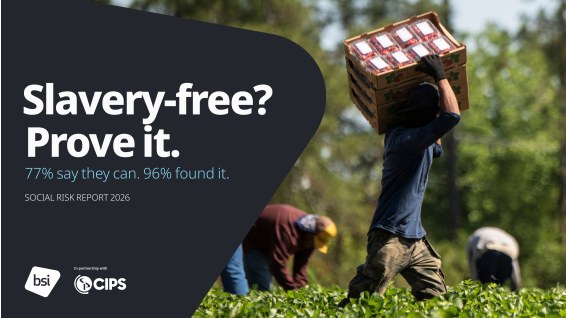
If you look for signs of slavery in your supply chain, you will find them. 96% of those undertaking due diligence reported instances of modern slavery, forced labour or serious labour rights violations in their supply chain in the last 12 months.
That is what new research shows from the British Standards Institution (BSI), in partnership with CIPS. The report demonstrates that, among those who view social issues as a business risk, due diligence activities designed to identify modern slavery risk are uncovering the reality of its malign existence within global supply chains. This is not an abstract supply chain issue, but one with human impact. Behind all the data points are real people. Procurement and supply chain professionals sit in a unique position to take effective action.
The challenge lies in turning confidence in compliance capabilities into credible action where it matters. Visibility remains poor beyond tier 1 suppliers; there are widespread barriers to building credible evidence; and no single activity stands out to improve risk identification.
The report features a foreword from anti-slavery charity Unseen, as well as expert commentary from CIPS global head of sustainability, Maxfield Weiss.
Download the report to discover:
- How due diligence efforts are unveiling the scale of the problem - but visibility remains low past tier 1 suppliers
- The growing confidence gap between compliance-led activity and evidence of real-world impact
- The biggest barriers organisations face when identifying modern slavery risk and evidencing impact
- How organisations are responding when they do uncover violations in their supply chain
- Practical recommendations to connect the dots, shift from activity to effectiveness, and protect workers
Findings are based on a survey of 600 procurement, supply chain, logistics and ESG professionals across the UK, France, Germany, Netherlands, Italy and South Africa.
To download please sign in.