
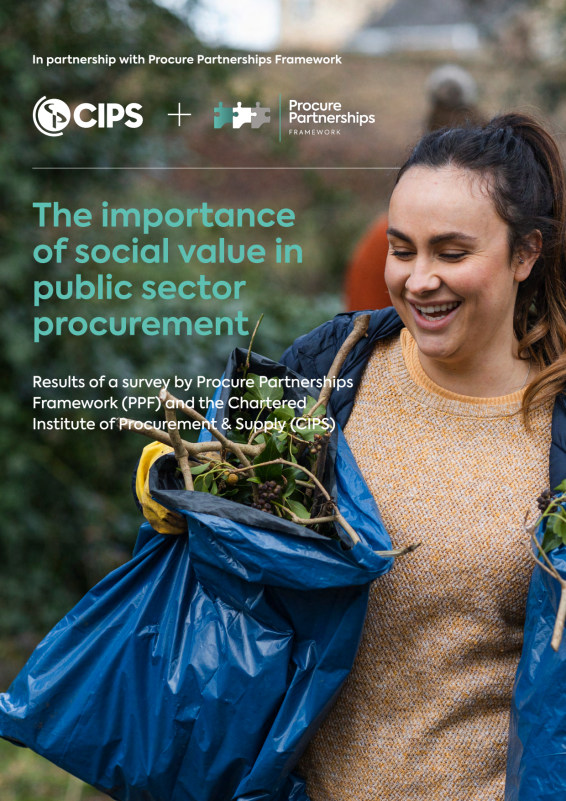

The importance of social value in public sector procurement

1 July

The importance of social value in public sector procurement

In light of the Procurement Act 2023 and the National Procurement Policy Statement (NPPS), which both place greater emphasis on achieving the most advantageous tender (MAT) outcomes, social value is no longer a peripheral consideration — it is central to public procurement decision making.

To help gauge how public sector organisations are responding to these developments, Procure Partnerships Framework (PPF) collaborated with the Chartered Institute of Procurement & Supply (CIPS) to carry out a sector-wide survey.

The aim was to identify key trends, opportunities, and barriers in social value delivery across the procurement lifecycle, from early-stage planning through to post-award tracking and reporting. 

Findings in the report include:

  • Outcomes are better when social value is embedded earlier in the process
  • There is a lack of dedicated social value resources in organisations
  • Joining forces with other public sector bodies is desirable

Download the report to discover more.

Related Expert Reports

The Contract-Aware Enterprise: From Contract Blindness to Commercial Advantage

Contracts contain some of the most valuable commercial intelligence in an organisation, yet too often that knowledge remains trapped in static documents and disconnected systems. In this whitepaper, Sirion explores how leading organisations are transforming contracts from passive records into actionable business intelligence. The aim? To drive stronger decisions, reduce risk, and unlock commercial value.


Slavery-free? Prove it.

Modern slavery operates in the shadows, but despite growing scrutiny, it's on the rise. This report explores why tackling modern slavery in supply chains remains a persistent challenge for organisations. Based on 600 responses, the British Standards Institution (BSI), in partnership with CIPS, conducted research into why this is. Read the report to get insight into visibility risks, barriers to addressing modern slavery, and practical recommendations to support effective remediation.